
The Red-Green Alliance


“Hamas and Hezbollah are social movements that are progressive, that are part of the left, that are part of the global left.”
— Berkeley professor and feminist theorist Judith Butler
One of the more perplexing political questions of our day is how leftist progressives end up aligned with Islamists. When Zohran Mamdani ran for office in New York City, he did so as a Muslim promoting the protection of transgender people, an idea that is completely out of step with his religious views. Yet Mamdani isn’t alone in this posture.
In recent years, an unexpected partnership has emerged between secular progressives or socialists and certain Islamist movements. It’s often called the Red-Green Alliance—“red” for the revolutionary left and “green” for political Islam.
This raises a fundamental question: how do left-wing activists reconcile their ideological commitments with support for extreme Islamic regimes and movements?
This dynamic is not entirely new. One of the clearest historical examples of ideological convergence between Western revolutionary thought and Islamic theocracy occurred during the Iranian Revolution of 1978–1979.
The Iranian Revolution and Michel Foucault
At the center of that moment stood an unlikely figure: the French postmodern philosopher Michel Foucault.
Foucault traveled to Iran multiple times in 1978 as protests intensified against Shah Mohammad Reza Pahlavi. Rather than viewing the uprising with skepticism, Foucault became one of its most prominent Western intellectual defenders. Writing for major European newspapers, he described the movement not merely as political unrest but as a profound “spiritual revolution” capable of challenging Western materialism and capitalist modernity.
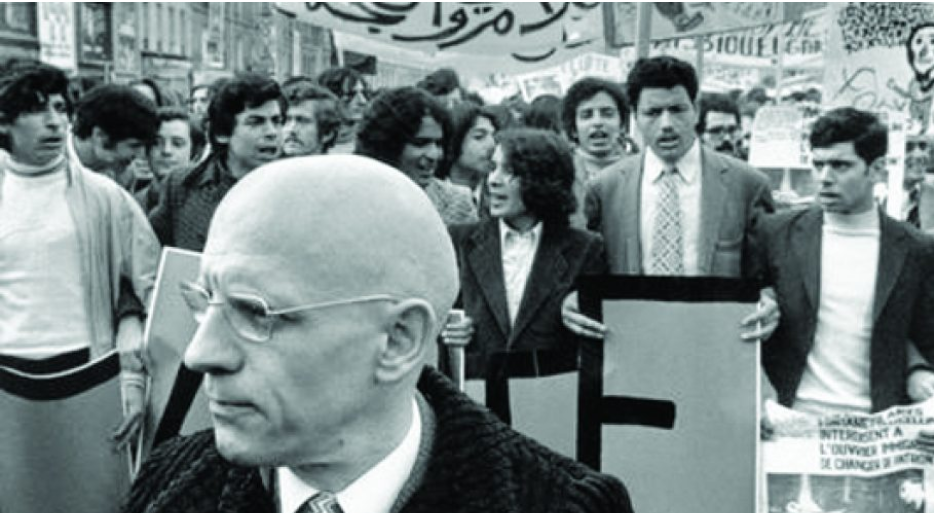
What fascinated Foucault was precisely what troubled many observers. The revolution was openly religious. Protesters were not demanding liberal democracy or socialist redistribution. Again and again, demonstrators called for an “Islamic government.”
Foucault interpreted this not as a warning sign but as a new form of revolutionary energy. He believed Islam could function as a force of resistance against Western political order and capitalist modernity. Religion, in his view, offered an alternative mode of collective identity capable of overturning entrenched systems of power.
In exile near Paris, Ayatollah Ruhollah Khomeini emerged as the symbolic leader of the movement. Foucault even met with Khomeini and publicly supported the revolutionary uprising that ultimately overthrew the Shah.
This moment illustrates what later commentators would describe as the Red-Green Alliance.
How the Red-Green Alliance Works
“Red” represents revolutionary leftist or Marxist movements motivated by anti-capitalism and anti-imperialism. “Green” represents Islamist movements motivated by religious opposition to Western secular modernity.
Despite radically different visions for society, both factions shared a common enemy: the Western-aligned liberal state.
In Iran, Marxists, secular leftists, Islamist clerics, student radicals, and sympathetic Western intellectuals formed a temporary ideological coalition against the Shah, whom they viewed as a symbol of Western capitalism and American influence.
Their unity was tactical rather than philosophical.
The left saw Islamism as an anti-imperialist liberation movement.Islamists saw leftists as useful allies in destroying the existing regime.
The alliance succeeded.
The Shah fell in 1979.
And then the coalition collapsed almost immediately.
Once in power, Khomeini’s regime consolidated authority and systematically eliminated many of its former leftist allies through imprisonment, exile, and execution. The revolutionary forces that had helped bring down the monarchy were no longer necessary once power had been secured.
Even Foucault himself became disillusioned as reports emerged of mass executions and repression under the new Islamic Republic.
History had delivered a harsh lesson.
Shared hatred of Western capitalism proved strong enough to unite deeply incompatible ideologies, but not strong enough to sustain freedom afterward.
The Red-Green Alliance in the Modern West
The alliance between revolutionary leftism and Islamic political movements did not end in Iran in 1979. What unfolded during the Iranian Revolution was not merely a historical anomaly involving Michel Foucault and Ruhollah Khomeini. It revealed a recurring political pattern that continues to surface across Western societies today.
The Red-Green Alliance describes a convergence between two ideologies that, at least on paper, should be irreconcilable.
The progressive left often champions secularism, sexual liberation, feminism, and LGBTQ identity politics. Islamist movements, by contrast, frequently uphold religious authority, traditional gender roles, and strict moral codes rooted in theology. Their visions for society appear fundamentally incompatible.
Yet cooperation repeatedly emerges because both share a common critique. Western civilization, capitalism, nationalism, and liberal democratic traditions are viewed as systems of domination tied to colonialism, imperialism, and historical injustice.
Shared opposition can create political alignment even where philosophical agreement does not exist.

In modern Western activism, this convergence increasingly appears in debates surrounding immigration, identity politics, and multiculturalism. Progressive movements frequently frame large-scale Muslim immigration into Europe and the United States primarily through the language of anti-racism and humanitarian obligation. Immigration becomes not simply a policy question but a moral test of Western tolerance.
Criticism of cultural integration challenges or ideological tensions is often dismissed as prejudice rather than debated substantively. As a result, deeply illiberal beliefs within certain religious or political movements are sometimes overlooked so long as those movements are framed as marginalized groups resisting Western power structures.
The alliance is therefore sustained less by shared values than by shared opposition.
Political and Civilizational Implications
Recent political developments in American cities illustrate this dynamic. In New York, figures such as Zohran Mamdani have risen within progressive political coalitions that combine democratic socialism, anti-capitalist rhetoric, and political advocacy rooted in postcolonial and identity-based frameworks. These movements frequently align themselves rhetorically with global struggles against Western influence, framing domestic politics as part of a broader resistance to capitalism and imperialism.
Across Europe, similar coalitions have emerged in which progressive activists defend expansive immigration policies while simultaneously forming political partnerships with religiously conservative communities whose social values sharply diverge from secular liberal norms.
The paradox is striking.
Movements that advocate gender fluidity, sexual autonomy, and secular governance often find themselves politically aligned with groups that reject those very principles. The alliance persists because the central organizing principle is not agreement about the future but opposition to the existing Western order.
This dynamic mirrors the logic visible in Iran decades earlier. Secular revolutionaries and Islamist clerics stood together long enough to dismantle a shared adversary. Only afterward did their incompatibilities become unavoidable.
The lesson of the Red-Green Alliance is not that cooperation across differences is inherently wrong. Democratic societies depend on coalition building. The warning instead is that alliances formed primarily around destruction rather than a shared constructive vision often produce dangerous outcomes.
History shows that dismantling institutions is far easier than building stable replacements.
When societies lose confidence in their own civilizational foundations, they create space for ideological movements that promise liberation without clearly defining what comes next. The Iranian Revolution demonstrated how quickly revolutionary enthusiasm can give way to authoritarian reality.
The question facing modern Western societies is whether they recognize similar ideological convergences forming within their own political and cultural landscapes.
The Cold War did not simply end. Its ideological tensions evolved, migrated, and reappeared in new forms. Today’s conflicts over identity, immigration, religion, and national identity are not isolated debates. They reflect a deeper struggle over the meaning and future of Western civilization.
Understanding the Red-Green Alliance helps explain why unlikely political partnerships continue to emerge and why cultural conflicts increasingly feel civilizational rather than merely political.
Ideas travel.Alliances shift.But worldviews endure.
And the struggle between them continues.

